

The agent gateway
The runtime your agents live in. One profile per agent, each running as its own service, so several agents can share a box without sharing an identity. Adding an agent doesn't disturb the ones already working.
This is the page for whoever asks the hard questions — your IT lead, your controller, or you at two in the morning. Nothing here is a black box, because a system you can't inspect is a system you can't trust with your ERP.
Your Prophet 21 database never leaves your network. The MeshHand server reaches into it over a connection you control — a VPN, an IP allow-list, or a small on-premise relay if you would rather not expose SQL at all.
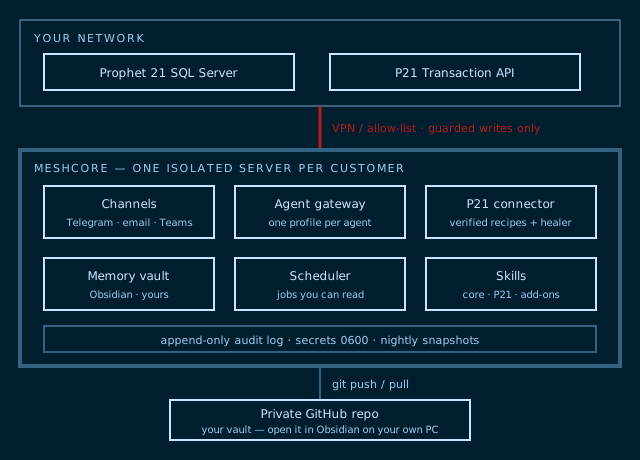
The runtime your agents live in. One profile per agent, each running as its own service, so several agents can share a box without sharing an identity. Adding an agent doesn't disturb the ones already working.
Each is two plain files: its role and standing rules, and a profile of your business — who's who, your timezone, your tools, how you like things done. We ship a template with the non-negotiable rules already baked in; you fill in the personality at onboarding.
One job, described in a folder, with its action class declared. That's what makes the approval model enforceable rather than aspirational — the class is decided when the skill is written, not by the model in the moment.
A private GitHub repository holding an Obsidian vault, cloned onto the server and pulled every three minutes. Ingested source material stays read-only; the agent maintains its own summaries; the rules file stays yours to edit. You can open the whole thing on your PC.
Scheduled jobs are declared in a file in your vault, so the timetable is something you can read, review, and change. Every run writes to the audit log, and anything that actually did something writes a line you can find later.
Reads go through a read-only login or OData. Writes go only through the Transaction API recipes we have verified live. Install-specific values — company id, location ids, hostnames — live in your own configuration file and never in the shared product.
The shape of a MeshHand rollout. The read-only weeks are not a formality — they are how you find out whether the agent understands your business before it is allowed to change anything in it.
Which three recurring jobs cost you the most, what channels your team actually uses, how we reach your P21 install, and who approves a guarded write.
We stand up your server, create your vault repository, install the packs, write your configuration, register your channels, and run the acceptance tests.
The agent runs briefs, monitors and draft-only skills. It writes nothing. You name it, correct what it has misunderstood, and tune how it talks.
We enable one guarded write at a time, each verified live on your install before it is switched on. No big-bang cutover.
We monitor your box — health, failed jobs, healer outcomes. Upgrades happen in a window you agree to.
You keep the vault; it was always in your repository. We revoke the keys and destroy the server. No exit project, no data to extract.
When a Prophet 21 write fails in a new way, the healer works out the fix, verifies it by reading the record back, and records it twice: once so the machine can apply it next time, and once as a written decision a person can audit.
Generalised lessons flow back into the product, stripped of anything identifying. Values specific to your install stay in your configuration and are never folded into the shared pack. So the fifth MeshHand customer gets a connector that already knows what the first four ran into — and none of them can see each other's data.
That is the compounding asset here, and it is why the P21 knowledge is the part that would be hardest for anyone else to copy.
Network path, credentials, what happens when it gets something wrong, what you're left holding if you cancel. Those are the right questions and we have answers for all of them.